
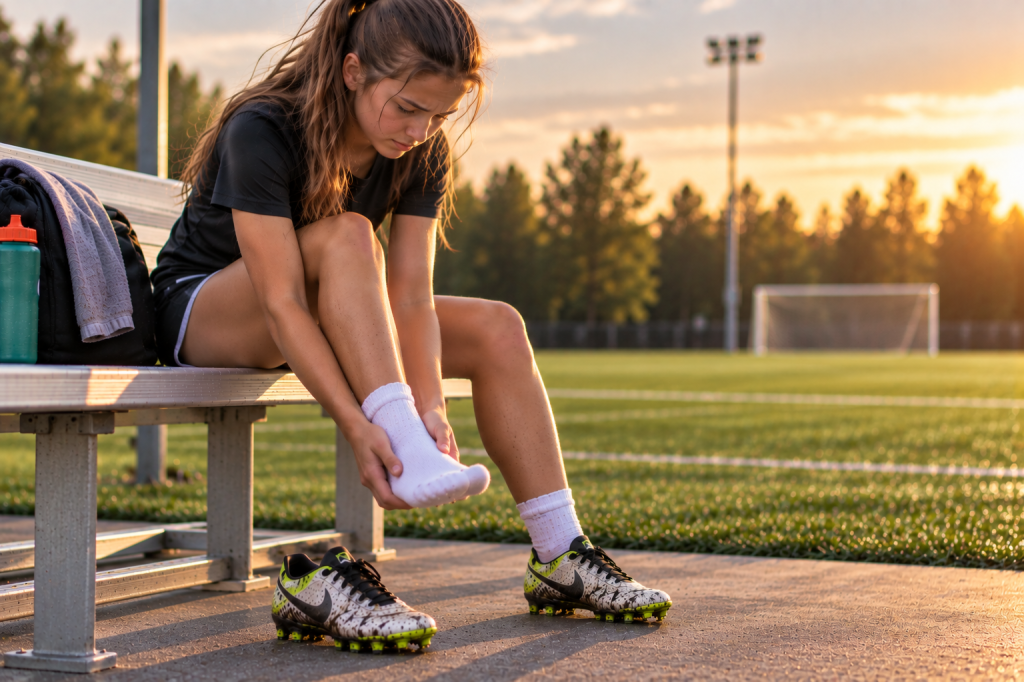
Buying kids’ cleats sounds simple until your player puts them on and says, “I don’t know. They feel fine.”
Helpful.
The problem is that cleats aren’t supposed to fit like everyday sneakers. A good pair should feel secure and fairly snug, without the foot sliding around inside the shoe. But there’s a difference between snug and too small—and when kids are still growing, figuring out which side of that line you’re on can be surprisingly difficult.
We’ve gone through this with both soccer and lacrosse cleats: comparing half sizes, checking where toes actually land, swapping insoles, changing socks and trying to decide whether a shoe that fits perfectly today will still fit a month from now.
The good news is that you don’t need a complicated measuring system.
For most kids, the goal is simple: the heel should stay secure, the foot shouldn’t slide inside the cleat, and the longest toe should be close to the end without being pressed or curled against it.
Soccer and lacrosse put somewhat different demands on footwear, but the basic fit principles are remarkably similar. Here’s what we look for.
How should kids’ cleats fit?
Kids’ soccer and lacrosse cleats should fit snugger than ordinary sneakers, particularly through the heel and midfoot. The foot should feel secure when running, stopping and changing direction rather than moving around inside the shoe.
At the front, you want a small amount of space beyond the longest toe—enough that the toe isn’t pressing painfully into the end of the cleat, but not so much that the foot can slide forward.
And make sure you’re checking the longest toe, not automatically the big toe. For some kids, the second toe is just as long or longer.
A little growing room is reasonable. A full extra size usually isn’t.
The best test isn’t just standing in the kitchen and pressing on the toe box. Have your child lace the cleats properly, wear the socks and insoles they’ll actually use, then walk, jog, stop hard and make a few side-to-side cuts.
That’s much closer to what the shoe actually has to do.

THE SIDELINE FIT TEST
✓ Heel stays securely in place
✓ Toes aren’t pressed or curled
✓ No painful pressure across the forefoot
✓ Foot doesn’t slide forward when stopping
✓ No side-to-side movement when cutting
✓ Tested with the actual socks and insoles they’ll wear
If all six are true, you’re probably very close.
How much toe room should kids’ cleats have?
This is probably the hardest part of fitting kids’ cleats, because parents are used to checking sneakers by pressing a thumb over the toe and looking for plenty of growing room.
With cleats, we want less empty space than we would in an everyday sneaker.
The longest toe should be close to the front of the shoe, but it shouldn’t be jammed against it. Your child should be able to stand, run and stop without feeling pressure at the end of the toe box—and their toes shouldn’t curl or bunch inside the cleat.
We wouldn’t get too obsessed with finding one perfect measurement. Different cleats have different toe-box shapes, and kids’ feet aren’t shaped alike either. A player with a longer second toe or sharply tapered smaller toes can have a cleat that looks roomy from the outside while the longest toe is already near the end.
That’s why how the foot behaves inside the cleat matters more than how much space you can press down in front of the toes.
Lace the cleats properly and have your player stand up. Then have them jog, stop hard and make a few cuts. If the toes hit the front when stopping, the cleat is probably too short. If the whole foot slides forward before the toes reach the end, it may be too big—or simply the wrong shape for that foot.
And don’t forget to check both feet. It’s normal for one foot to be slightly larger than the other, and the larger foot should drive the sizing decision
Snug vs. too small: how can you tell?
A properly fitted cleat can feel noticeably snug when a kid first puts it on. That’s especially true with performance-oriented models designed to wrap closely around the foot.
Snug is okay. Pain isn’t.
A good snug fit should feel secure around the heel and midfoot without squeezing the toes together. There shouldn’t be obvious heel lift, and the foot shouldn’t move side to side when the player cuts.
A cleat is more likely too small or too narrow if your child feels pinching, numbness, pressure on the ends or sides of the toes, or pain across the forefoot. Toes that have to curl to fit are an easy no.
Width matters here too. Going up half a size isn’t always the right solution to a cleat that feels tight. Sometimes the player simply needs a different-shaped shoe—or an actual wide width. That’s particularly worth remembering in lacrosse, where models such as New Balance’s current Burn and Freeze lines are offered in multiple widths rather than forcing every foot into the same shape.
The goal isn’t the tightest cleat your kid can tolerate. It’s the smallest fit that stays comfortable and secure during actual play.
Don’t buy cleats too big just so they’ll last longer
Kids grow fast. Cleats aren’t cheap. So the temptation is obvious: buy them a little big now and maybe they’ll make it through another season.
We understand the logic. We just wouldn’t take it very far.
A little growing room is reasonable. Buying a noticeably oversized cleat isn’t.
Extra space inside a cleat allows the foot to move before the shoe moves with it. The heel can lift, the foot can slide forward when stopping, and the player may feel less secure when accelerating or changing direction.
That’s exactly the opposite of what we’re trying to accomplish with a properly fitted cleat.
There’s also a practical problem with the classic “they’ll grow into them” strategy: you don’t actually know how your kid’s foot is going to grow. A shoe that’s too long today may eventually become the right length—but it could still be too narrow, too wide or simply the wrong shape six months from now.
Our approach is to buy the cleat that fits properly now, while allowing a small amount of reasonable room at the toes. If we’re stuck between two sizes, we’ll test both with the player’s actual socks and insoles and pay close attention to heel movement and what happens when they stop hard.
We’d rather have a cleat fit correctly for the months it’s being used than spend an entire season waiting for a too-big shoe to become the right size.
Growing room should be extra space at the front of a properly fitting cleat—not a foot sliding around inside an oversized one.
Do soccer and lacrosse cleats fit differently?
Not as much as you might think.
Whether we’re fitting soccer or lacrosse cleats, we’re looking for the same fundamentals: a secure heel, a snug midfoot, comfortable toes and very little movement of the foot inside the shoe.
Where the sports differ is more in how the cleats are built and what they’re designed to do than in how much empty space you should leave inside them.
Soccer cleats tend to prioritize a close connection between the foot and the ball. Nike, for example, describes some of its soccer boots as having a contoured fit specifically designed to minimize the space between the foot and the ball. That’s one reason soccer players often prefer a particularly close-fitting boot.
Lacrosse cleats don’t need to help you feel or strike a ball with your foot. Instead, the emphasis is heavily on traction, acceleration, stopping and lateral cutting. That can lead to different outsole designs, more structure around the foot and, depending on the model, different collar heights. New Balance’s current Burn lacrosse cleat, for example, is designed for a snug fit with lockdown through the midfoot and is available in narrow, standard and wide widths.
But that doesn’t mean we’d deliberately fit a lacrosse cleat looser.
A lacrosse player planting hard for a change of direction doesn’t want their foot sliding sideways inside the shoe any more than a soccer player does. In both sports, the shoe should move with the foot—not wait for the foot to move inside the shoe first.
So we’d use essentially the same fit test for both sports. What may change is which cleat fits that particular foot best.
A kid who loves a narrow, close-fitting soccer boot may prefer something completely different for lacrosse. And two models from the same brand can fit differently enough that the size printed on the box only gets you into the neighborhood.
OUR RULE:
Fit the foot first and the sport second. Once the shoe fits securely and comfortably, then worry about the outsole, surface, collar and sport-specific features.
The socks and insoles matter more than you think
A cleat doesn’t fit your child’s bare foot. It fits their foot, sock and insole together.
That sounds obvious, but it’s surprisingly easy to forget when you’re trying on shoes.
Start with the socks. If your player normally wears a particular game sock—or a thicker performance or grip sock—bring that exact pair when trying on cleats. Even Nike specifically recommends trying soccer cleats on with the same socks you’ll actually wear during play.
Insoles can make an even bigger difference.
We’ve experienced this ourselves with aftermarket cleat insoles. Once you replace the thin factory liner with something that provides more structure or cushioning, the usable space inside the cleat can change enough to affect which size feels right.
Our players use CURREX CleatPro insoles, which are specifically designed to be thin enough for narrow field-sport cleats and can be trimmed using the original factory insole as a template. CURREX markets the same CleatPro for both soccer and lacrosse, among other field sports.
That’s why we wouldn’t fit a new pair of cleats using the factory insole if we already know it’s coming out as soon as we get home.
Bring the actual socks. Bring the actual insoles. Fit the complete setup your kid is going to play in.
And if changing the insole suddenly makes an otherwise good cleat feel cramped, don’t assume the cleat just needs to “break in.” Recheck the fit. The combination may simply be taking up too much room for that particular shoe
How do you know when your kid has outgrown their cleats?
Kids don’t always announce that their cleats are getting too small.
Sometimes they don’t notice. Sometimes they assume cleats are supposed to hurt. And sometimes they’ll happily wear the same pair until their toes are trying to escape through the upper.
So during a season, it’s worth checking the fit occasionally—especially during a growth spurt.
The most obvious sign is that the longest toe has reached the end of the cleat and is starting to feel pressure. But we’d also pay attention to new rubbing, blisters, numbness, cramped toes or complaints that a cleat suddenly feels uncomfortable even though it was fine a few weeks ago.
You may also notice the upper beginning to bulge around the toes or forefoot as the foot takes up more space inside the shoe.
And don’t assume length is the only thing that changes. Growing feet can change in width and overall shape, too. A cleat may still technically be long enough while becoming uncomfortable across the forefoot.
One particularly useful clue is simply a change from the player’s normal experience. If the same cleats and socks have been comfortable for months and suddenly your child is loosening the laces, complaining about pressure or immediately taking the shoes off after practice, check the fit before assuming the cleats just need to be broken in again.
For kids who play year-round, we’d make the fit check part of the routine rather than waiting for a complaint. Pull out the insoles, have them stand on them and look at where the toes land. Then put everything back together and repeat the same standing, stopping and cutting test you used when buying them.
Cleats don’t suddenly shrink. Kids’ feet suddenly grow.
Quick answers for parents
Should kids’ cleats fit tighter than sneakers?
Yes, generally. Soccer and lacrosse cleats should have a closer, more secure fit than everyday sneakers. The heel and midfoot shouldn’t move around, and there should be less empty space in front of the toes—but snug should never mean painful.
Should I size up half a size for growing room?
Not automatically. If the larger size still holds the heel securely and doesn’t allow the foot to slide when stopping or cutting, a little extra room can be reasonable. If sizing up creates movement inside the shoe, we’d buy the smaller size that fits correctly now.
Will cleats stretch as they break in?
Some materials may soften and conform to the foot with use, but we wouldn’t buy uncomfortable cleats expecting them to become significantly longer or wider. A pressure point that hurts in the store is a reason to try another size or model—not a break-in strategy.
The bottom line
Getting kids’ cleats to fit correctly doesn’t require a perfect measurement or a complicated sizing formula.
Whether they’re playing soccer or lacrosse, we’re looking for the same basic things: a secure heel, a snug midfoot, comfortable toes and a shoe that moves with the foot instead of around it.
Leave a little reasonable room for growing feet, but don’t sacrifice the fit today hoping the cleats will last another season. And always test them with the socks and insoles your player will actually wear.
Most importantly, listen to the kid wearing them. A cleat can look perfect from the outside and still be completely wrong for their foot.
Snug is good. Secure is good. Pain isn’t.
 Sideline Selects
Leave a comment