
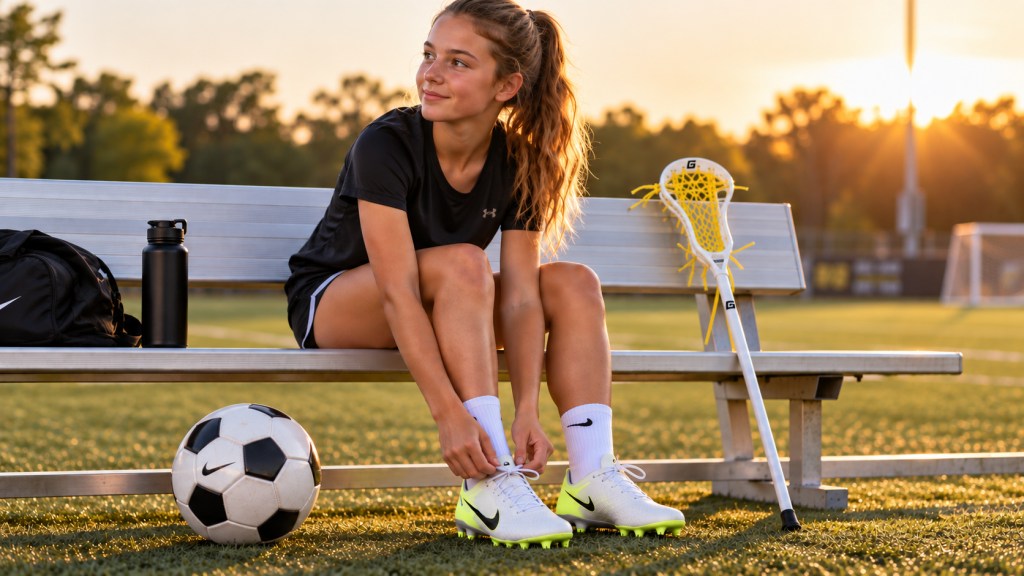
If your kid plays both soccer and lacrosse, you’ve probably had this thought:
Do we really need another pair of cleats?
It’s a reasonable question. Both sports are played on grass and artificial turf, both involve plenty of sprinting and cutting, and from a few feet away the cleats can look pretty similar.
The short answer is that soccer cleats can generally work very well for lacrosse, especially for youth players.
But that doesn’t mean soccer and lacrosse cleats are identical.
Soccer cleats tend to prioritize lightweight construction, traction and a close connection between the foot and the ball. Lacrosse-specific cleats are built without worrying about ball touch and may put more emphasis on lockdown, lateral cutting and support. Current designs illustrate that difference: Nike describes its soccer models around things like lightweight construction, ball control and traction, while New Balance describes its BurnX5 lacrosse cleat specifically around midfoot lockdown and lateral cuts.
Whether those differences matter enough to buy another pair depends on the player, the cleat and the surface they’re playing on.
Here’s what we’d look at before spending money on another pair.
Can kids wear soccer cleats for lacrosse?
Yes. For many youth lacrosse players, a properly fitting pair of soccer cleats can work perfectly well for lacrosse.
The important questions aren’t really which sport is printed on the shoebox. They’re whether the cleats fit securely, provide appropriate traction for the playing surface and allow the player to run, stop and change direction comfortably.
That’s especially relevant for kids who play both sports.
If your child already owns soccer cleats that fit well and feels comfortable playing lacrosse in them, we wouldn’t automatically replace them simply because lacrosse season started.
In fact, many of the things soccer cleats are designed to do translate pretty naturally to lacrosse. Soccer players also accelerate, stop and make hard changes of direction. Current soccer models use stud patterns specifically designed for those movements; Nike, for example, describes the chevron studs on its Mercurial Vapor as helping players stop and change direction.
There are still legitimate differences between soccer and lacrosse cleats, and those differences may become more noticeable as players get older, faster and more aggressive with their cuts.
And because youth rules can differ by age, league and discipline, we’d always check your specific league or tournament rules before assuming any particular cleat is permitted. USA Lacrosse itself publishes separate youth rules for boys and girls and age-appropriate youth guidance.

OUR RULE:
Don’t buy a second pair just because the box says “lacrosse.” Buy it when the lacrosse-specific cleat actually solves a problem.
What’s the difference between soccer and lacrosse cleats?
At first glance, soccer and lacrosse cleats can look almost interchangeable. Both are lightweight athletic shoes with molded studs designed to provide traction on grass or artificial turf.
The differences are mostly about what each shoe is optimized to do.
Stud patterns and traction
Both sports require players to accelerate, stop and change direction quickly, so there’s plenty of overlap in how the outsoles are designed.
Soccer cleats often use a combination of bladed, chevron or conical studs designed to provide traction while still allowing the foot to release and rotate naturally during play. Different soccer models can feel surprisingly different underfoot depending on how aggressive that stud pattern is.
Lacrosse cleats are also built for acceleration and stopping, but manufacturers may put additional emphasis on lateral traction because lacrosse involves so much hard planting, dodging and cutting. New Balance, for example, describes the outsole of its current Burn lacrosse cleat as providing traction for lateral cuts.
That doesn’t mean a lacrosse outsole is automatically better. A good soccer cleat already has to handle plenty of multidirectional movement.
It simply means the two shoes may approach traction somewhat differently.
What about the toe cleat?
This is where things get confusing.
You’ll sometimes hear that soccer cleats can’t be used for lacrosse because they don’t have a stud at the very front of the shoe—or that any cleat with a front stud is automatically illegal.
We wouldn’t use either rule of thumb.
Cleat layouts vary considerably between models, and the presence or absence of one particular stud isn’t enough by itself to tell you whether a shoe is appropriate—or permitted—for your child’s league.
More importantly, don’t apply rules you’ve heard about baseball or football cleats to lacrosse without checking. Equipment requirements aren’t interchangeable between sports.
For organized lacrosse, the safest approach is simple: check the rules for your player’s league or tournament rather than trying to identify a legal shoe solely by looking at the outsole. USA Lacrosse publishes different rules by discipline and age level, and local leagues can have additional requirements.
Support and lockdown
This may be a more noticeable difference than the studs themselves.
Soccer cleats generally try to keep unnecessary material away from the foot. A lighter, closer-fitting upper helps preserve the player’s feel for the ball.
Lacrosse doesn’t have that requirement.
That gives manufacturers more freedom to build structure around the foot specifically for running and cutting. Some lacrosse models emphasize midfoot lockdown, lateral stability or additional structure around the ankle and upper.
That can be useful for a player who feels like their foot is moving inside a lightweight soccer boot during aggressive cuts.
But more material doesn’t automatically mean more support, and a higher collar doesn’t magically protect an ankle. Fit still matters more than how substantial the shoe looks.
Weight and feel
This is one area where some multi-sport kids may actually prefer their soccer cleats.
Soccer boots are often designed to feel light and streamlined. A player who’s accustomed to that sensation may find a more structured lacrosse cleat bulky by comparison.
Other players may have the opposite reaction. They may prefer the more substantial, locked-in feeling of a lacrosse-specific shoe.
Neither preference is wrong.
If your kid can sprint, stop and cut confidently in their soccer cleats—and their foot stays securely in place—we wouldn’t change shoes simply because another model is marketed specifically for lacrosse.
Not sure whether the cleat itself fits correctly? See our guide to How Should Kids’ Cleats Fit?
When do soccer cleats make sense for lacrosse?
For a lot of youth players, the answer may simply be: when they already have a pair that fits well.
If your child plays soccer and lacrosse, there’s no reason to assume they need a separate pair of cleats for each sport. A good soccer cleat already provides traction for sprinting, stopping and changing direction, and many kids will be perfectly comfortable using the same pair for lacrosse.
We’d be especially comfortable sticking with soccer cleats when:
- Your child is younger or relatively new to lacrosse. There’s little reason to build a sport-specific shoe collection before you know what they actually prefer.
- The soccer cleats already fit extremely well. A familiar shoe that stays securely on the foot can be a better choice than a lacrosse-specific cleat that doesn’t fit as well.
- Your child plays both sports during the same season. One good pair may be simpler—and considerably cheaper—than maintaining two pairs in the correct size while their feet are growing.
- They prefer a lightweight cleat. Kids accustomed to soccer boots may genuinely prefer the lighter, closer-to-the-foot feel.
- They aren’t having traction or stability problems. If your player can accelerate, stop and cut confidently, there’s no problem we’re trying to solve.
That last point is the one we’d pay the most attention to.
It’s easy to shop based on what a cleat is supposed to do. We’d rather watch what actually happens on the field.
If your child comes off the field comfortable, isn’t slipping during cuts, isn’t experiencing heel movement or foot sliding, and never gives their cleats a second thought, that’s a pretty good argument for leaving things alone.
Kids’ feet grow quickly enough. We don’t need to invent reasons to buy more shoes.
When are lacrosse-specific cleats worth buying?
Soccer cleats can work extremely well for lacrosse, but there are situations where we’d consider moving to a lacrosse-specific pair.
The biggest reason is simple: your current cleats aren’t doing something your player needs them to do.
Maybe your child feels their foot moving inside the shoe during hard cuts. Maybe they’re slipping more than they’d like when planting and changing direction. Or maybe they’ve tried a lacrosse cleat and simply feel more secure in it.
That’s when the differences we talked about earlier start to matter.
We’d consider lacrosse-specific cleats when:
- Your player wants more lockdown or structure. Some lacrosse cleats are designed specifically around securing the foot during aggressive lateral movement.
- They’re having trouble with traction when cutting. If the current soccer cleats consistently feel unstable during dodges or changes of direction, a different outsole may help.
- A lacrosse model fits their foot better. This one is easy to overlook. Some lacrosse cleats are available in multiple widths, which can be a huge advantage for kids who struggle with the shape of traditional soccer boots.
- They simply prefer the feel. Once players have enough experience to recognize what they like underfoot, that preference matters.
And we’d put age and level of play pretty far down the list.
An older or more competitive player may be more likely to notice differences between cleats because they’re moving faster and cutting harder. But that doesn’t mean every serious lacrosse player automatically needs a lacrosse-specific shoe.
If a soccer cleat fits securely and the player feels confident in it, we wouldn’t replace a shoe that’s working just to get one with “lacrosse” in the product description.
On the other hand, if your player keeps mentioning slipping, instability, pressure points or a lack of confidence when planting, that’s useful information. At that point, trying a lacrosse-specific model makes sense.
The goal isn’t to find the cleat that’s theoretically best for lacrosse.
It’s to find the cleat your kid forgets they’re wearing once the game starts.
A quick note about width
One advantage of shopping outside traditional soccer boots is that you may have more choices for unusually narrow or wide feet.
For example, New Balance currently offers its BurnX5 lacrosse cleat in narrow, standard and wide widths, rather than relying entirely on sizing up to accommodate a wider foot.
That’s important because going up in length isn’t a good fix for a shoe that’s too narrow. You can end up with enough width across the forefoot but too much space in front of the toes and movement at the heel.
If width is the problem, we’d rather find a shoe built for that foot shape than compensate by buying a longer cleat.
What about turf?
There’s another question we’d ask before worrying about soccer versus lacrosse:
What surface is your kid actually playing on?
A soccer cleat that works beautifully for lacrosse on natural grass may not be the shoe we’d choose for every artificial surface.
And unfortunately, “turf” doesn’t describe just one thing.
Many newer artificial fields use longer synthetic grass with infill and are designed to behave more like natural grass. Other facilities—especially indoor fields and older outdoor complexes—use shorter, denser turf that can feel more like carpet.
Those surfaces can call for very different footwear.
On natural grass and many modern artificial-grass fields, molded soccer or lacrosse cleats may work well. On shorter artificial turf, we’d usually look toward a turf shoe with lots of smaller rubber traction points rather than longer molded studs.
That isn’t really a soccer-versus-lacrosse decision. It’s a cleat-versus-surface decision.
And it’s worth paying attention to because youth players can bounce between surfaces constantly. A weekend might include a game on wet natural grass, another on a modern synthetic field and a midweek practice at an indoor turf facility.
We wouldn’t necessarily expect one pair of shoes to be ideal for all three.
Don’t trust the word “turf” alone
This is where we’d look at the actual field rather than just the schedule.
If it looks and behaves like synthetic grass—with visible blades and infill—the footwear options may be very different from a short, tightly packed indoor surface.
Facilities and leagues may also have their own footwear restrictions, so check the rules for the field you’re playing on, particularly indoors.
For multi-sport families, this can actually change how we’d spend the money.
If your kid already has soccer cleats that work perfectly well for outdoor lacrosse, we’d be much more inclined to spend the second-shoe budget on a good pair of turf shoes than on another pair of molded cleats that performs essentially the same job.
OUR RULE:
Match the shoe to the surface before worrying about the sport printed on the box.
Quick answers for parents
Are soccer cleats allowed in lacrosse?
Generally, yes. Soccer cleats are commonly suitable for lacrosse, provided they meet the rules of your child’s league or tournament.
We wouldn’t rely on the shape of the studs alone to decide whether a particular shoe is permitted. Rules can vary by age, league and competition, so if there’s any question, check with the organization running the games.
Does my kid need separate cleats for soccer and lacrosse?
Not necessarily.
If your child’s soccer cleats fit securely, provide good traction and allow them to sprint, stop and cut comfortably during lacrosse, we wouldn’t buy another pair simply because they’re playing a different sport.
A second pair makes more sense when it solves an actual problem—different field surfaces, poor traction, fit issues, or a player who prefers the additional structure or feel of a lacrosse-specific cleat.
Can kids wear turf shoes for lacrosse?
Yes, when they’re appropriate for the playing surface and permitted by the facility or league.
Turf shoes can be particularly useful on shorter, denser artificial surfaces where longer molded studs may not be the best choice.
On natural grass or longer artificial grass, we’d generally want footwear designed to provide enough traction for those conditions.
The important distinction isn’t just soccer versus lacrosse. It’s also cleats versus turf shoes—and which one matches the field your kid is actually playing on.
The bottom line
If your kid already has a pair of soccer cleats that fits well, we wouldn’t rush out to buy lacrosse cleats just because lacrosse season started.
For many youth players, soccer cleats can handle the running, stopping and cutting required for lacrosse perfectly well.
Lacrosse-specific cleats become worth considering when they solve something the soccer cleats don’t: better fit, more secure lockdown, different traction, additional structure or simply a feel your player prefers.
And don’t overlook the playing surface. In some situations, adding a pair of turf shoes may be more useful than owning two different pairs of molded cleats.
Ultimately, we’d worry less about the sport printed on the box and more about what happens when your kid actually plays in them.
If the cleats fit securely, match the surface and your player can run, stop and cut confidently, they’re probably doing their job.
 Sideline Selects
Leave a comment